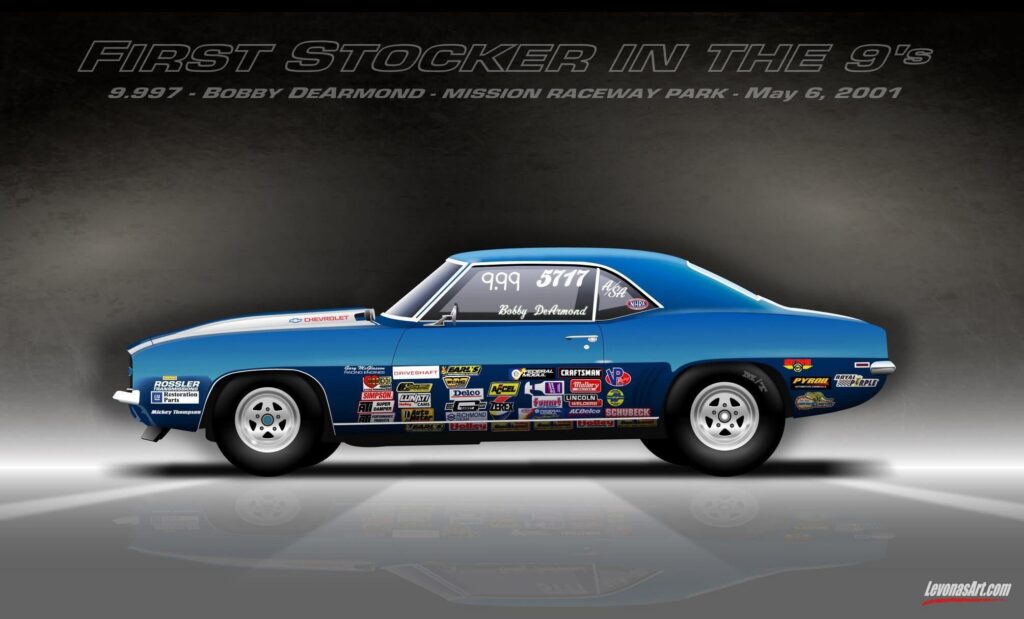
On May 6th 2001, Bobby DeArmond records the first 9 sec Stocker run in NHRA history at Mission Raceway Park. The following article is courtesy of Brenda Grubbs. All Track Records are available at this link.
Like many racers, Bobby started young. Growing up, in Gallup, New Mexico, his family owned and operated a trucking business. To keep the cost down and ensure quality work, young Bobby, along with his dad and brothers, performed all required maintenance and repairs on the trucks. Therefore, it was no surprise when Bobby developed a passion for cars. In a town full of muscle cars, Bobby owned the bragging rights for the fastest street legal car. By the time he turned 18, Bobby was racing his 1970 LS6 Chevelle at the closest dragstrip. However, at 140 miles away in Albuquerque, New Mexico, the strip was hardly close. To maintain and upgrade the car, Bobby worked for three years as a parts man for Rico Motor Company, the local GMC/Pontiac/Buick/Oldsmobile/Cadillac dealership, which is still in business today.
Bobby’s dedication and resourcefulness were readily apparent and he quickly found the wave of good fortune, winning the New Mexico State Championship and still has the championship jacket to this day. Buoyed by his success, Bobby drove his 396/350 Chevelle to the 1971 AHRA Winter Nationals at Bee Line Dragway in Scottsdale, Arizona. Once at the track, race preparation began as headers were uncapped and tires traded out for slicks and the process was reversed each night prior to heading to the motel. One night while driving to the motel, Bobby was cited by the police for an obstructed windshield as he forgot to remove the shoe polish from the race day. The weekend was met with other challenges as well. During one pass, Bobby shifted his Hurst Super Shifter into third gear and his right hand was badly cut by the ashtray, which had been left open by a friend. All was not lost as Linda Vaughn, “Miss Hurst,” was able to provide first aid. While the scar may be long gone, Miss Linda Vaughn left Bobby with a memory he will never forget. For the next few years, Bobby faithfully attended the AHRA Winter Nationals and in 1973, set his first national record.
Taking a few years off from drag racing, Bobby took up motocross and desert-raced motorcycles in the 125cc and 250cc classes, mostly on Yamahas. After numerous operations and broken bones from injuries sustained during riding, the decision was made to return to his first passion, drag racing. Wanting to make the move into the highly competitive Stock Eliminator class, Bobby purchased a turnkey F/Stock 1969 Chevy Z28 Camaro that he debuted at the 81 Winter Nationals. Wanting to go even faster, he set his sights on racing an A/SA Camaro. After hearing about a ‘69 Z28 Camaro in a field outside of Cortez, CO, he went to look at the car and asked if the price was negotiable. To answer his question, the car’s owner commanded his pit bull to attack a small tree. As the tree was being demolished, Bobby decided the price was fair, even without an engine and a wrecked left front end. Bobby sold his F/S ’69 Z28 and began the transformation into an A/SA BBC 427ci/425 hp beast. After five months in the body shop replacing quarter panels and the trunk lid, the car debuted in 1982. At the initial race, Bobby ran an 11:19 on the 11:17 national record and thought Stock Eliminator was easy. Wanting to set a new record, he decided to purchase a few trick pieces, however, after replacing the converter, cam, headers, and shocks, the car ran high 11:30s. It took nearly a year of testing to sort out the car and get back into the low 11:20s. Bobby learned three things; Stock Eliminator was not easy, keep good records and only make one change at a time to the car.
In 1994, the wave of good fortune once again came his way. Bobby won his first NHRA national event at the Mile High Nationals, when after a lengthy final round rain delay, NHRA inserted the Stock Eliminator final ahead of Top Fuel. Dick LaHaie had the right lane picked for his driver, however, when Bobby’s win light came on in the left lane, LaHaie was heard saying, “If that lane is good enough for the A/SA Camaro, it’s good enough for us.”
At the World Finals in 1999, Bobby qualified second going faster than the national record. At the time, talk was circulating in the racing community about a Stocker being able to put a nine second run on the scoreboard. A racing publication identified 10 racers capable of such a feat, and one was Bobby DeArmond. Determined to achieve the goal, with the help of friends Ritch Ahrens and Gary McGlasson, the adventure began, crisscrossing the continent in search of “The Perfect Wave” – a 9-second run. Only a few weeks later, Bobby and Gary headed to the NHRA National Open at Orlando Speedworld in Florida, an event known for being fast. To help with the quest, VP Racing Fuels had sent a new fuel to Orlando for Bobby to use. Bobby decided to use the fuel on the final qualifying round of the evening as the night air was getting cool. A swell was building when all of a sudden the wave came crashing down when at the initial hit the welds on the axle perches broke. When the welds broke, the entire rear end housing rotated in the u-bolts, and what was left of a twisted driveshaft and pinion, cut through an OE gas tank filled with fuel. Fifteen gallons of VP Racing Fuel spilled on the track and with sparks flying, the NHRA Safety Safari Team opened the driver’s door and told Bobby to shut the engine off and get out of the car. Bobby was lucky to survive the catastrophe and the Safety Safari prevented a total loss of the car. Soon after, a new NHRA rule allowing fuel cells in Stockers was implemented. This was the first of two new rules that came as a direct result of Bobby’s quest.
The search for the perfect track, weather conditions and perfect wave continued with Bobby racing all seven NHRA divisions attending national and divisional events. The year 2000 included another trip back to the NHRA National Open in Orlando, Florida. However, this time, Bobby never made it to the track. While driving through Dallas, the transmission in his truck broke. After replacing the transmission, the decision was made to return to Gallup as they would be unable to make the event in time for the last round of qualifying.
The highs and lows of the adventure continued, and Bobby told a friend he would either go into the nine’s or go bankrupt trying. In April of 2001, good weather was forecast for the Atco divisional event in New Jersey and Bobby was on the road again, driving 2,000 miles to the track. This time, Bobby had the horsepower and the good air. For a second time, the swell was building. When the tree came down, the car launched into a massive wheel stand landing hard 300 feet down track, crushing the headers and oil pan, cracking the torque converter, breaking the transmission case and knocking the car out of alignment. Once again, the wave of adversity had struck. This situation resulted in the second rule change; wheelie bars were made legal for Stock Eliminator. Bobby headed home to fix the damage.
The failure at Atco turned out to be a valuable learning experience. Post-race analysis and conversations with other racers led Bobby to the realization a change to the chassis setup was required. A month later and after a lot of work, Bobby, Gary and Ritch headed to Mission, British Columbia. At the race, Bobby was joined by four other racers also thought to be capable of a 9 -second Stock Eliminator run. After three years, it finally looked as though Bobby’s goal was within reach. Straight off the trailer on test day, Bobby ran 10.03 seconds. Trying different settings during the event resulted in no ET gains. Not to be discouraged, on Saturday night, Bobby saw the Division 6 Director and announced he was going into the 9’s in the morning and asked to have the engine sealed and torn down. With the new day came the best air of the weekend. As Bobby and crew prepared the car for the first round of eliminations, on the window was the dial-in of “9.99”.
As Bobby drove into the staging lanes, heads turned to see the 9.99 on the window. The excitement began to swirl; was today the day a Stocker would make history? Other contenders in the search for the perfect wave saw Bobby’s dial-in and changed theirs to “9.99”. To add to the anticipation, Bobby was sandwiched between the other 9-second run contenders, with two lined up before him and two behind. With Bobby looking on, the two drivers in front failed either spinning or getting loose on the track. The wave was building as Bobby came to the line. The tree came down, the car launched smoothly, and in just under 10 seconds, it was over. After three years, countless disappointments, tens of thousands of miles, and the help of new and old friends, Bobby had found his perfect wave – a 9.997-second run.
As the Canadian Stock Eliminator fans went wild, Bobby reported to the scales. Not wanting any doubt, or question, Bobby requested the motor be immediately torn down. With the help of Gary and Ritch, the engine was given not the standard NHRA tear down, but was completely disassembled, measured and weighed, all while being videotaped. The motor was found completely legal. It was official – on May 6, 2001 Bobby DeArmond entered the history books as the first Stocker to run in the nines.